Most men own one jacket that fits, and they found it by accident.
They wore it out of a store one afternoon, or bought a size that happened to be right. Ever since, it has been the reference: “I'm a 40.” Then a wedding comes, or a new jacket, and the guess has to hold up.
Two measurements give you a better starting point: your chest and your height. Take both, then check them against the specific jacket's sizing information. Sizes vary by cut and brand.
Start with your chest
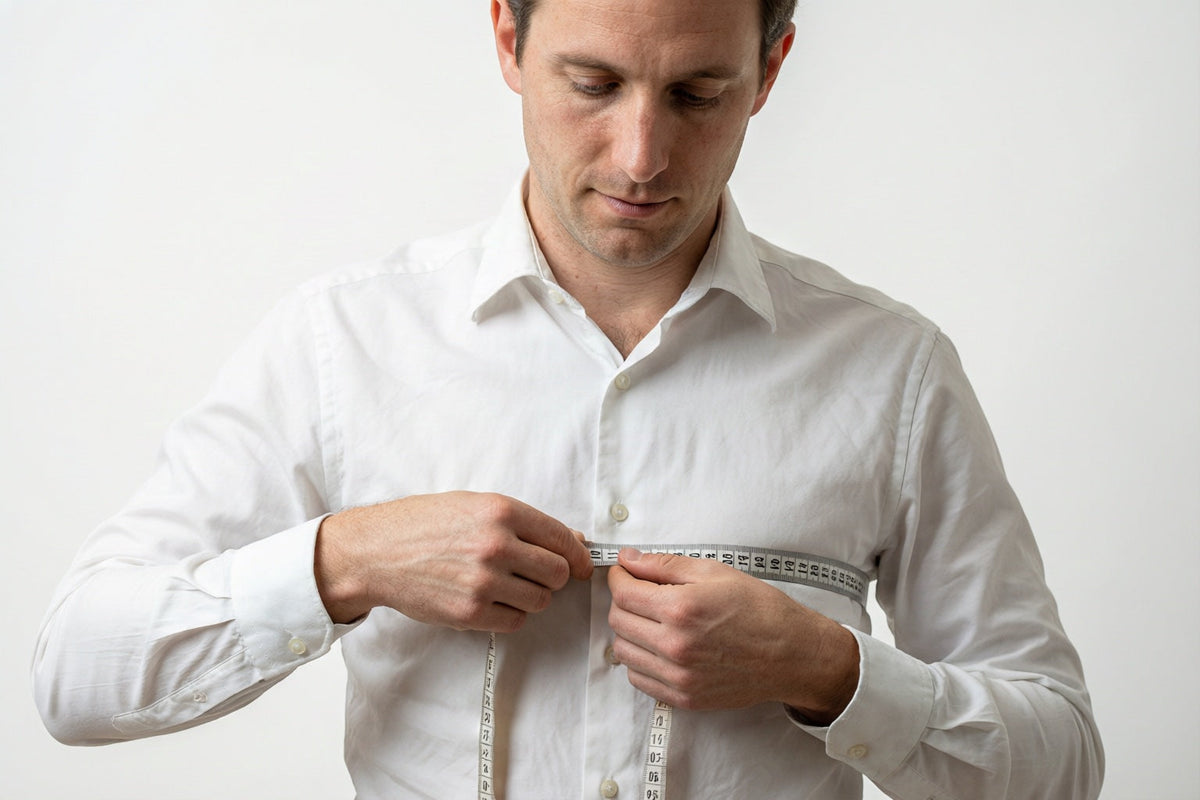
You need a soft measuring tape. Wear a thin shirt, stand relaxed and wrap the tape around the fullest part of your chest, passing under your armpits.
- Keep the tape level. Check the back in a mirror or ask someone to help.
- Breathe normally. Don't puff out your chest or pull your stomach in.
- Keep it snug without compressing. The tape should lie flat without digging into your shirt.
Write down the measurement in inches. Repeat it once to check that the tape stayed level.
Read the number as a starting size
A 40-inch chest often starts at a US size 40 jacket, but that is a starting point rather than a fit guarantee. A jacket includes room for your shirt and movement; the garment's measurement is not the same as your body's.
Flex Tailor blazers currently run from 36 to 52. Tuxedo jackets offer Regular and Short options. The olive green suit has a wider size range, from 34R to 54R. Check the options on the product you're buying.
If you fall between sizes, compare the specific cut and ask for guidance. Stretch helps with movement, but it does not correct a shoulder that is too wide or sleeves that are too long.
Understand Regular and Short
The letter after a jacket size describes its length, not how broad you are. A Short jacket generally has a shorter body and sleeves than the same numbered size in Regular.
Your height is useful context, but body proportions matter too. There is no height cutoff that works for every jacket. Tell us your height and how your current jacket fits before choosing a length.
Use your best-fitting jacket as a reference
Lay it flat without stretching the fabric. Measure across the chest from armpit to armpit and double that figure for an approximate garment chest measurement. Also record the back length and sleeve length.
Use those measurements only when the comparison garment has been measured the same way. They are not a substitute for your body measurement, and we do not currently publish a complete garment-measurement chart for every style.
Check the fit in the mirror
- Shoulders: the seam should sit near the edge of your shoulder, with no obvious overhang or pulling.
- Chest: fasten the intended button. The front should sit comfortably rather than forming a strong X-shaped pull.
- Sleeves: a little shirt cuff showing is a useful traditional reference; check it with your arms relaxed.
- Length: look at the jacket from the side and back. It should suit your proportions and the intended cut.
Finally, sit down, reach forward and stand again. The jacket should feel comfortable through those ordinary movements.
The two-minute version
- Measure your chest over a thin shirt with the tape level.
- Record your height and usual jacket size.
- Check the exact product's size and length options.
- Compare against a jacket you already like.
- Ask before ordering if you're between sizes.
Send us your measurements and the style you're considering, and we'll help you choose a starting point. You can also browse the stretch blazers collection.


